Normally, I find Small Diaphragm Condenser microphones to be somewhat utilitarian. They have a purpose; they capture great sound, and on some occasions might feature a pad or a roll-off. But they don’t necessarily need to be fancy. Plug it in, position it, and off to the races… but what if it could do even more? That is where the Universal Audio SP-1 comes in.
This stereo pair of small diaphragm condensers can be used in the traditional way, but when used with the included Hemisphere modelling plug-in, gives even more sonic and convenient options.
First Thoughts
One of the first things anyone will notice about the SP-1s is just how expensive they look and feel. In terms of fit, finish, and (while not a real metric to pay too much attention to) weight, there seems to be something that would cost up to double their price point.
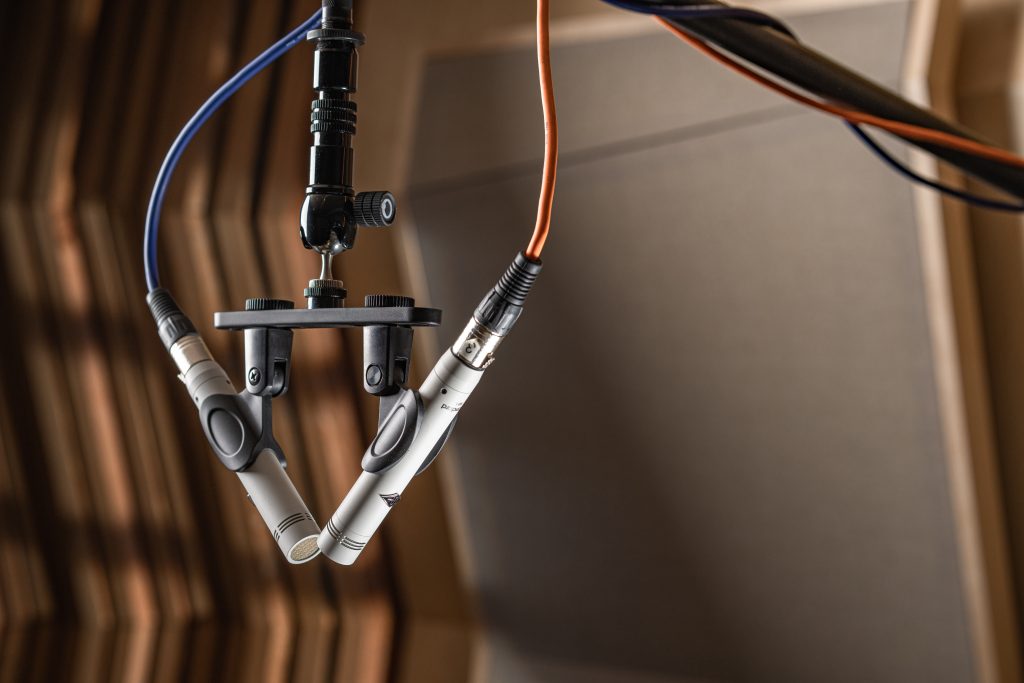
Unboxing is a simple affair, and you will find the two microphones, alongside two microphone clips, the appropriate thread adapters, two foam windshields, and a plastic stereo bar. Everything feels quite sturdy and premium, except the stereo bar, which, while adequate enough, I am not 100% sure would survive on a stand that is knocked over, for example. Everything included is contained in a premium kind of coated cardboard that features a handle, so the whole thing doubles up as a carrying case. This will keep the microphones protected, but I can imagine that at some point this would need replacing by a more substantial option, such as a Pelican Case, or one of the many similar alternatives.
In the case, you also receive a small card pamphlet with a QR code that takes you to UA’s site for registration, which activates the ?? year warranty, as well as adds the Hemisphere plugin license to your Universal Audio account. The plugin works both natively and on the UAD platform for near-zero latency monitoring of the effect.
Sold as a matched stereo pair, the SP-1s measure in at 128 mm (5“) long, with a diameter of 23.5mm (0.93”), and weigh 125 grams (0.28 lbs) each, making them quite compact, meaning they should be easy to position nice and close to sources, without getting in the way too much.
Specs-wise, these feature a cardioid polar pattern, a frequency response of 20Hz-20kHz, and a maximum SPL of 142dB (before 1% THD), and as you can imagine require +48v Phantom Power. One curious thing is that any mention of Signal-To-Noise ratio and Self Noise are admitted from the manual and any specification sheet. Let’s make our own judgement there when it comes to testing.
In Use
Like many pencil condensers, the SP-1s are designed primarily to be used on a host of acoustic instruments, whether that’s on acoustic guitar, percussion, as drum overs, on a piano, on strings, on brass, or really anything you can throw them at.
For the following testing, the SP-1s were plugged directly into an Apollo interface, recorded into Logic Pro, completely flat.
One place where a good stereo pair can shine is on a drum kit, especially as a pair of overheads, and the SP-1s can even work for some close-miking applications. Not only do they sound good, but their 142dB max SPL means there is very little fear of distorting the mic.
Overall, the SP-1s give a good performance and have a lovely smooth top end that gives plenty of detail, without turning cymbals harsh or piercing, while still retaining good levels of mids and lows, giving a solid overall picture of the drum kit as a whole. Defined attack is beautifully picked up, and the two mics give an overall solid stereo image of the kit.
There is even scope for using a single SP-1 as a hi-hat mic, or even as a bottom snare mic, to capture all that high-end information in good detail.
They perform equally well on many kinds of percussion, capturing plenty of body and attack, while remaining defined.
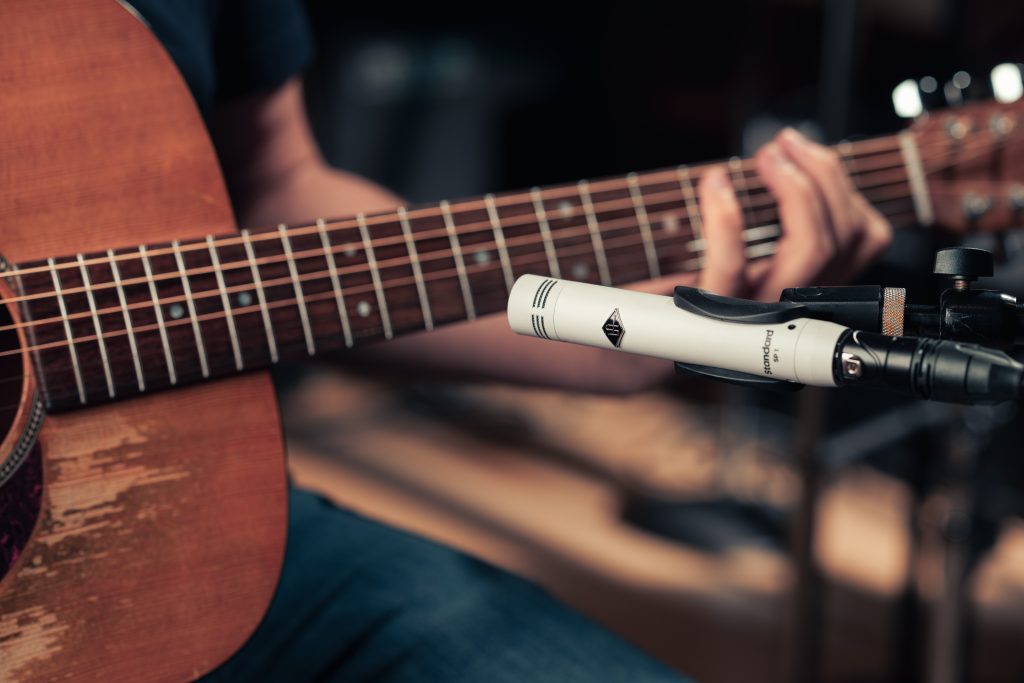
On acoustic guitar, the SP-1s probably give their greatest performance, whether used as a single close mic, or as a stereo pair slightly backed off. A stunning balance of tone, with decent body, and plenty of detail. Capturing all the little articulations that make up the sound of a guitar, such as the attack of the pick.
While there are plenty of other sources these mics excel on, such as piano and strings, there is one application that people often ignore, and that’s using a single one of them as part of a Blumlein mic array. Pairing one of the SP-1s with a nice figure-of-8 condenser (a Warm Audio WA-47 in our case, reviewed here) can give even more powerful sonic options. A drum kit sounds great with just the two on them, with very little reinforcement needed from close mics, etc.
Equally, that same array would work to capture a small choir, or ensemble really well, with plenty of detail, without lacking weight.
When used as a pair, whether as an XY, Coincident, or ORTF pair, the SP-1 does a fantastic job of properly capturing a 3-dimensional space with plenty of definition and great imaging.
One SP-1 sounds great; two of them give you so many options to experiment and play around with 3D space.
And For My Next Trick…
Let’s ignore that the SP-1s have already given a solid performance, because they are only part of the equation. The other key component of the sum is the Hemisphere Mic Collection plugin. This plugin takes the SP-1 and uses emulation to ‘turn them into’ various other famous small diaphragm condenser microphones. In UA’s own words, this isn’t simply adding an EQ curve, but more a process that emulates various sonic characteristics of the original microphones. This, along with a few other controls (more on those in a moment), adds an additional level flexibility to the SP-1s and can be used during tracking (near-zero latency with Apollo interfaces) or applied to an already recorded track, so you could record flat, and make sonic decisions later.
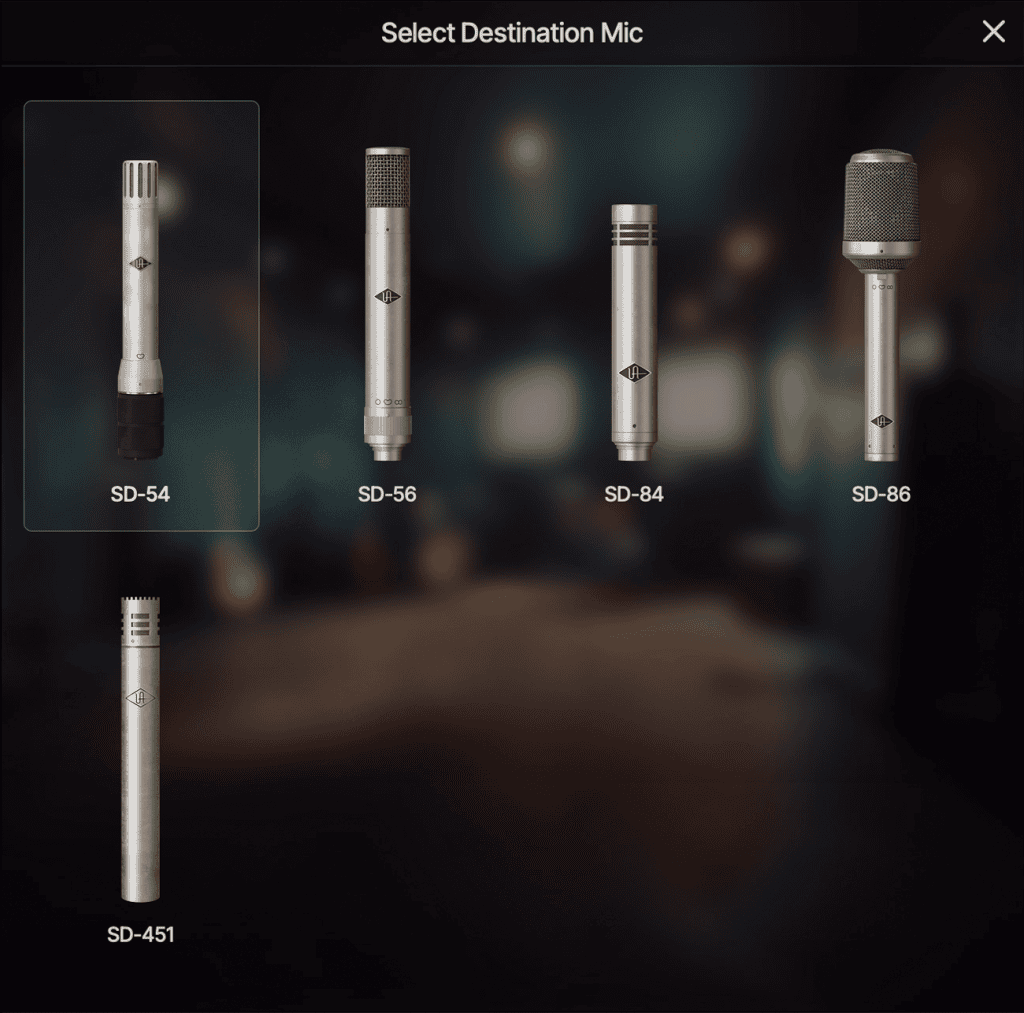
The Hemisphere Mic Collection has 5 emulation models that are inspired by vintage models: the SD-54 (Neumann KM-54), SD-56 (Neumann KM-56), SD-84 (Neumann KM-84), SD-86 (Neumann KM-86) and SD-451 (AKG 451). Does it get them 100% accurate? Of course not; emulation never does, but it gives the SP-1 a while range of different, and extremely usable sounds, that you normally wouldn’t get without owning six different microphones (the SP-1 Flat, and then the five emulations). Each of the emulations has a little blurb that not only gives some element of history, but even a sort of application suggestion of what the famous inspiration was used for.
Outside of just applying the emulation, the Hemisphere plugin also adds four additional controls: a polarity switch, a Filter control which adds 3 levels of high-pass filter, Proximity, which adds or removes a small amount of proximity effect, and lastly an Axis control that allows you to change the angle of the microphone by up to 180 degrees (up to 360 when used with the polarity switch). And much like the application of the emulation itself, these controls can be used both before or after you’ve recorded a track. This, to some level, means you could be a little less detailed when placing mics, and get maybe 75-80% of the way with physical positioning, and then a final tightening of ‘position’ using the software. This gives an impressive additional level of flexibility.
Wrapping Up
If you are looking for a pair of Small Diaphragm Condensers that will be an absolute studio workhorse, then the Universal Audio SP-1s should definitely be worth your consideration. Whether you record acoustic or electric guitar, strings, piano, percussion, drums, or just want a great pair to record the room, you probably won’t be disappointed in these as an option. The Hemisphere Mic Collection plugin gives the already versatile microphones even more power, but even if you wanted to ignore the plugin’s existence, the microphones are still a great investment. If you want to add more versatility from a pair of small diaphragm condensers to your microphone collection, then look no further than the Universal Audio SP-1 Stereo Pair,
In terms of alternatives for a straight-up SDC, you could look at something like a pair of Rode NT-5s or a pair of SE Electronics SE8, which are both solid, flexible microphones, but obviously lack the additional power of the included emulation. If emulation is something you are into, you could also look into the Slate Digital ML-2A, which does some very similar to the SP-1, and while it includes a wider range of emulations (some more variation of results and consistency), it lacks the abilities the SP-1s have when used with an Apollo interface, for example.
Universal Audio SP-1
£338/€389/$341
https://www.uaudio.com/products/sp-1-standard-pencil-microphones
Silence The Noise
Earlier in the review I mentioned the lack of ‘Noise-based’ specs in the manual and in any marketing, so I should add that during research for this review, I did read many first-hand accounts where people ended up with SP-1s that were slightly faulty and were noisier than normal. But we also read many accounts where customers received great mics that had little to no audible noise. The majority of these people with a fault had their units replaced, and aside from 1 account, all got replacements that worked as intended. The set of mics we used for this review, which we sourced privately, did not have this issue and were completely fine. However, for full transparency, we felt it was important to mention it.