
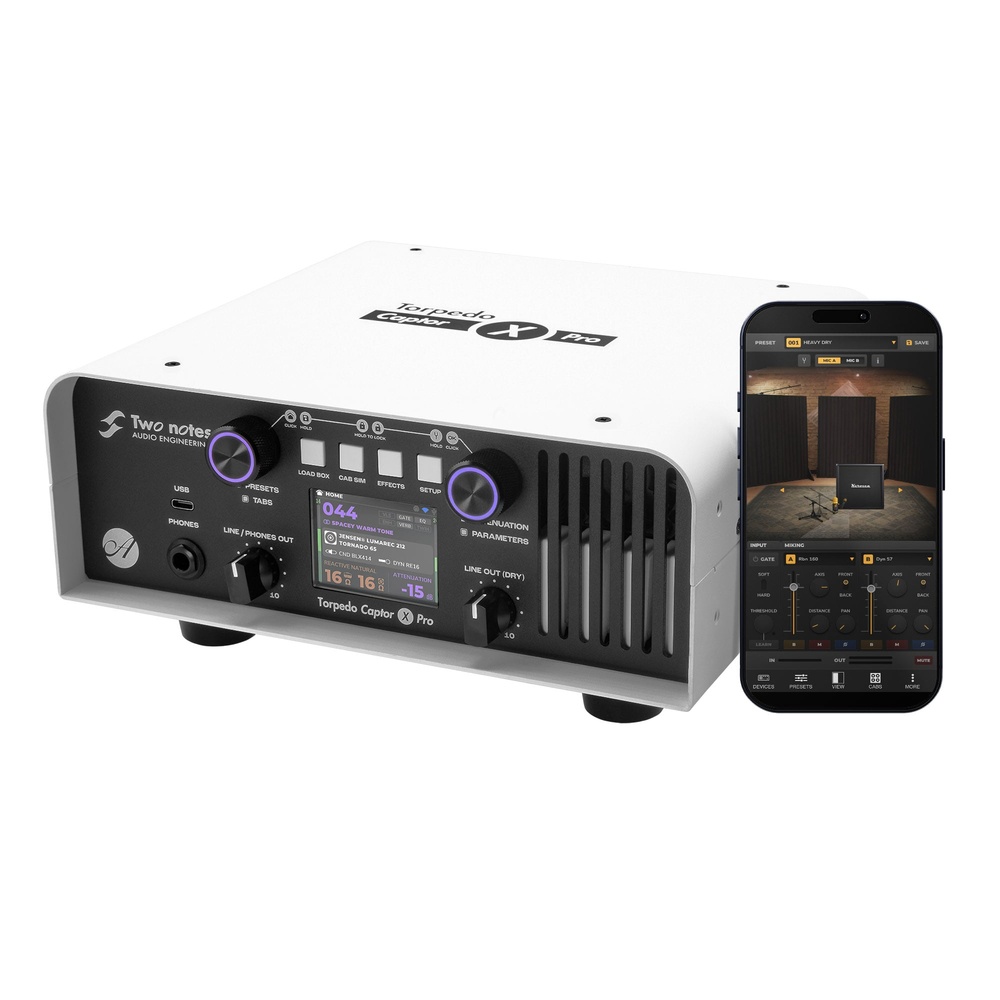
Two Note Audio Engineering have revealed that a new and improved version of their hugely popular reactive load box is on the horizon. Said to be the most advanced amplifier-control platform to carry their name, the Captor X Pro combines a 150W multi- impedance reactive load with programmable passive attenuation and advanced Torpedo processing, and offers some comprehensive analogue and digital routing options.
The Captor X Pro is built around a new 150W Multi-Impedance Reactive Load circuitry, which supports 4, 8 and 16-Ohm amplifiers and is said to preserve the dynamics, feel and harmonic response of any connected speaker cabinet. The reactive load is complemented by a relay-controlled programmable passive attenuator with multiple attenuation stages, allowing the unit to drive amplifiers to their ‘sweet spot’ without excessive volume. Silent recording is possible, too, and the Captor X Pro offers connectivity for direct recording with no speaker cabinet required.
Thanks to the latest generation of Two notes’ True Stereo DynIR Engine, the new arrival allows two microphone signals or static impulse responses to be positioned independently across the stereo field with separate processing chains and output assignments. Dual Mono routing then extends the flexibility even further, enabling completely independent cabinet, microphone and effects-processing chains. The Captor X Pro ships with 24 premium virtual cabinets, each of which feature eight microphone signals and offer continuous microphone positioning.
All of the system’s major function can be accessed directly from the front panel, while deeper editing is handled through the Torpedo Remote application for macOS, Windows, iOS and Android. From there, users are able to access up to 128 onboard presets, configure their routing, edit DynIRTM cabinets, customise Virtual Load Shaper settings and build complete performance rigs through an intuitive interface. Mono pre- and stereo post-FX loop architecture provides flexible integration with external hardware processors, while balanced stereo line-level and DI outputs, dedicated speaker and headphone outputs, USB-C, MIDI cover just about every base in the studio and on stage.