
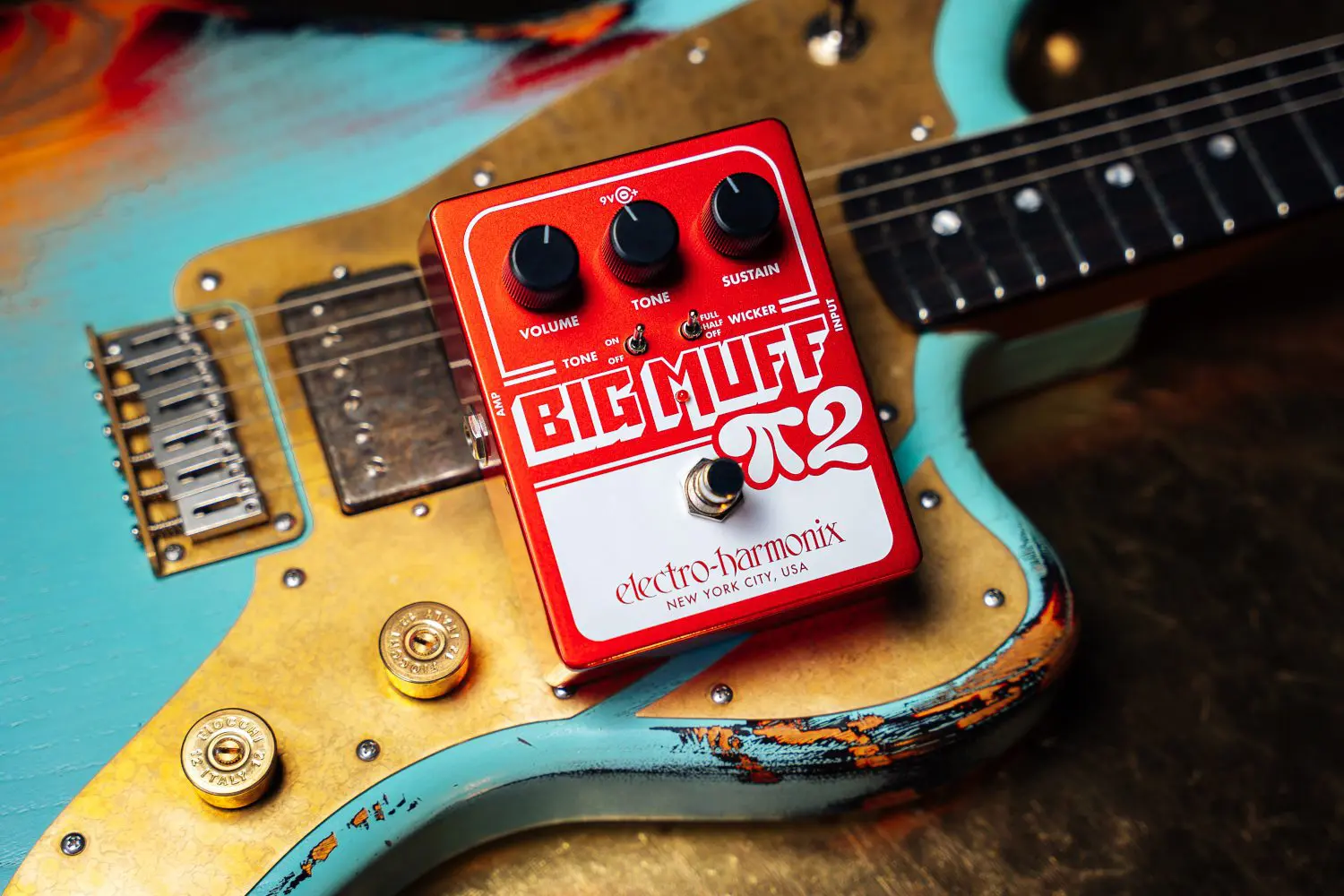
In the world of Fuzz Pedals, no other name is as synonymous as Electro-Harmonix’s Big Muff. There is a reason why it’s been such a staple for many a guitarist since its original design and release back in 1969. Throughout its almost 50-year life, it has been through many iterations, offering changes, some small and some not so small. One such bigger change was the somewhat introduction of the Big Muff 2.
(SIDE BAR BOX EXPLAINING JHS DISCOVERY)
First Impressions
Upon initial unboxing of the Big Muff 2, the first thing that will grab anyone’s attention is the striking metallic red colouration. That, coupled with white graphics and black control knobs, really makes the pedal pop; this thing will look great on any and all pedal boards.
In terms of size, the Big Muff 2 comes in a case that is essentially a slightly modded ‘Hammond 1950BB’, which measures in at 119mm x 94mm x 34mm (4.7”x 3.7”x 1.34”), making it not as small as some of Electro-Harmonix’s Nano range, but still compact compared to the size of the Original Big Muff, and the larger regular version of the Big Muff 2 (sans Tone Wicker)
Control-wise, you have exactly what you might expect from a Big Muff: Volume, Tone, and Sustain, but you also have the addition of two additional miniature switches: a 2-way switch to control the Tone bypass, and a 3-way switch that controls the wicker portion of the circuit. More on both of them later. In terms of ins and outs, the pedal features guitar in and amp out on ¼ jacks, and a 9v DC Input for powering (can also be powered off a 9v battery).
There is one other feature that this pedal has that some might not expect, and may take a little getting used to for some: it contains a ‘soft’ footswitch. What this means is that if you stomp on the switch, it functions like a regular ‘latching’ footswitch, but if you press and hold the switch, it acts as a ‘momentary’ switch. This does mean you have a bit more control over how the effect works for you, but it does mean you lose the satisfying click normally associated with a guitar pedal’s footswitch.
In-Use
The Big Muff 2 with Tone Wicker is at its heart a clear and obvious member of the Big Muff family. A pretty flexible member of the family as it happens. If you are looking for that enormous ragged-edged sound with violin-like sustain, then this version of the Big Muff has got your back, but it also has so much more.
The use of dual op-amps instead of gives, to my ears at least, two key characteristics: a tighter and more extended range of low-end and lower mid-range, and when pushed, a little more aggression and bite. Imagine taking a regular muff, and pushing it all to 11.
Hit a big power chord, and you’ll immediately get that thick, compressed Muff sound, or hit some lead lines for screaming sustain that can linger on. Is it subtle? Hell no, it’s a Big Muff.
So, we come to the Tone bypass switch. This 2-way (On-Off) switch essentially switches out the entire tone section of the Big Muff 2 circuit, which gives a more direct voicing of what a Big Muff does. This sound sometimes feels bigger, sometimes a bit darker, and overall, maybe a little thicker, which is perfect if that is what you are looking for.
While I personally love the stronger low-end of the Big Muff 2, a knock-on effect of that lower-end can then swallow up the top-end, leading to tones that have a reduced brightness and less top-end detail. That is where the Wicker switch comes into play. This 3-way switch (Off-Half-Full) opens up the top-end response of the pedal in two different levels (Half and Full). This gives the pedal more bite and definition, can bring out some pick articulation, make solos sing, and just help the overall part cut through a dense mix better.
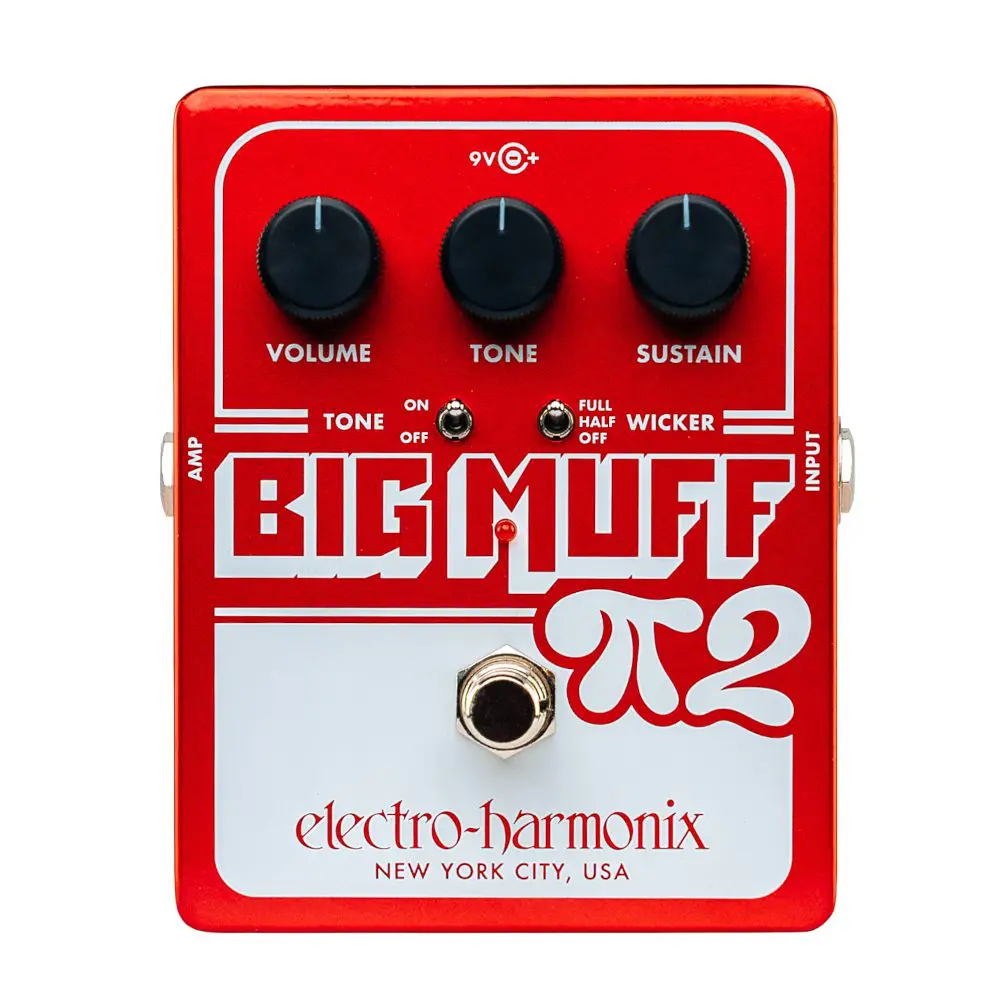
Playing around with the Tone control with the Wicker engaged gives more range to the tone, and at the higher end of the Tone control’s range, can lead to a tone that is quite a bit more aggressive. Perfect for helping parts cut through a mix in a wall of other guitar parts.
One issue I did, on occasion, run into was with certain guitars (mainly brighter-sounding guitars): with the Wicker engaged, and the Tone control past around 1 o’clock, the guitar sound got this kind of over-pronounced spitty quality that I can’t imagine anyone would be looking for, but dialling back the tone made that go away.
The versatility of this pedal grows exponentially when you start adding other pedals. I played around with a transparent overdrive before the Big Muff 2, and an EQ pedal (switching between before and after the Big Muff), and just these two pedals gave me a wealth of even more options. I can imagine playing around with additional compression, and even something like an Octaver could yield even bigger and better results.
Wrapping Up
The Big Muff 2 with Tone Wicker answers a question I didn’t know I was asking: ‘What if a Big Muff had more range, and was more versatile?’ The answer is a pedal that can achieve those vintage-style fuzz tones, but can also pump out much rougher, nastier modern tones that some guitarists have been craving. Especially those who love what the Big Muff does, but wanted more higher-end definition without having to add more pedals.
What I love about the Big Muff 2 with Tone Wicker is that Electro-Harmonix didn’t look at the chaos that a Big Muff creates and find a way to remove it; they just gave the artist tools to contain that very same chaos. And who doesn’t love a bit of chaos in their lives?
While there will be situations where the large sound that the Big Muff 2 puts out is a bit too much for denser full-band mixes, I think there are many situations where it is worth the effort to make it work. I can see many an artist, whether they’re playing Rock, Desert Rock, Indie, Hard-Rock, Alternative or even Doom, finding a place for this pedal on their board.
For those genres, if this isn’t a must-have, it has to be a strongly considered candidate for your pedal board. I know one thing for sure: this is a new permanent fixture on my own personal pedal board.
In terms of alternatives, I would maybe look at different pedals in the Big Muff 2 range; don’t need the Tone Wicker features? Check out the regular Big Muff 2. Want something more compact? Check out the Big Muff 2 Pi. Want a balls-to-the-wall overtop version? Look at the Big Muff 2 Deluxe, which features the same Tone Wicker features, but also adds a Gate, a Blend control, a Mids control, and an Expression Pedal input that can turn the Big Muff 2 into a Fuzz-Wah pedal.
Electro-Harmonix Big Muff 2 Tonewicker
£121/€139/$137
https://www.ehx.com/products/big-muff-pi-2-with-tone-wicker/