I love a good tube microphone. There is just something about a tube that adds a certain je ne sais quoi that can really elevate a sound. But is this true of all tube microphones at all price points? Well, that is where the CV-12 from New York-based manufacturer Avantone Pro enters the stage.
The CV-12 gets its name and overall silhouette from the famous, and ever popular AKG C-12, a microphone that has been sought after for over 60 years. But picking up a genuine C12, whether vintage or the reissued C12VR, will cost you at the very least a touch over £5000, so a tad cost-prohibitive for the home studio space. Does the vastly cheaper (currently around £300 in places) Avantone CV-12 recreate the sound at that price, is it a flop, or is it just a nice-sounding microphone that shares a look and some numbers with a famous friend?
First Impressions
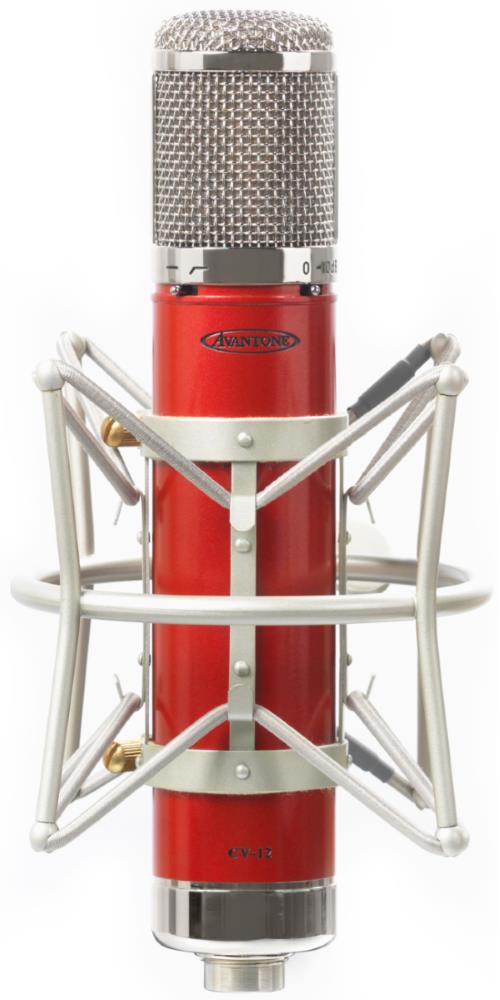
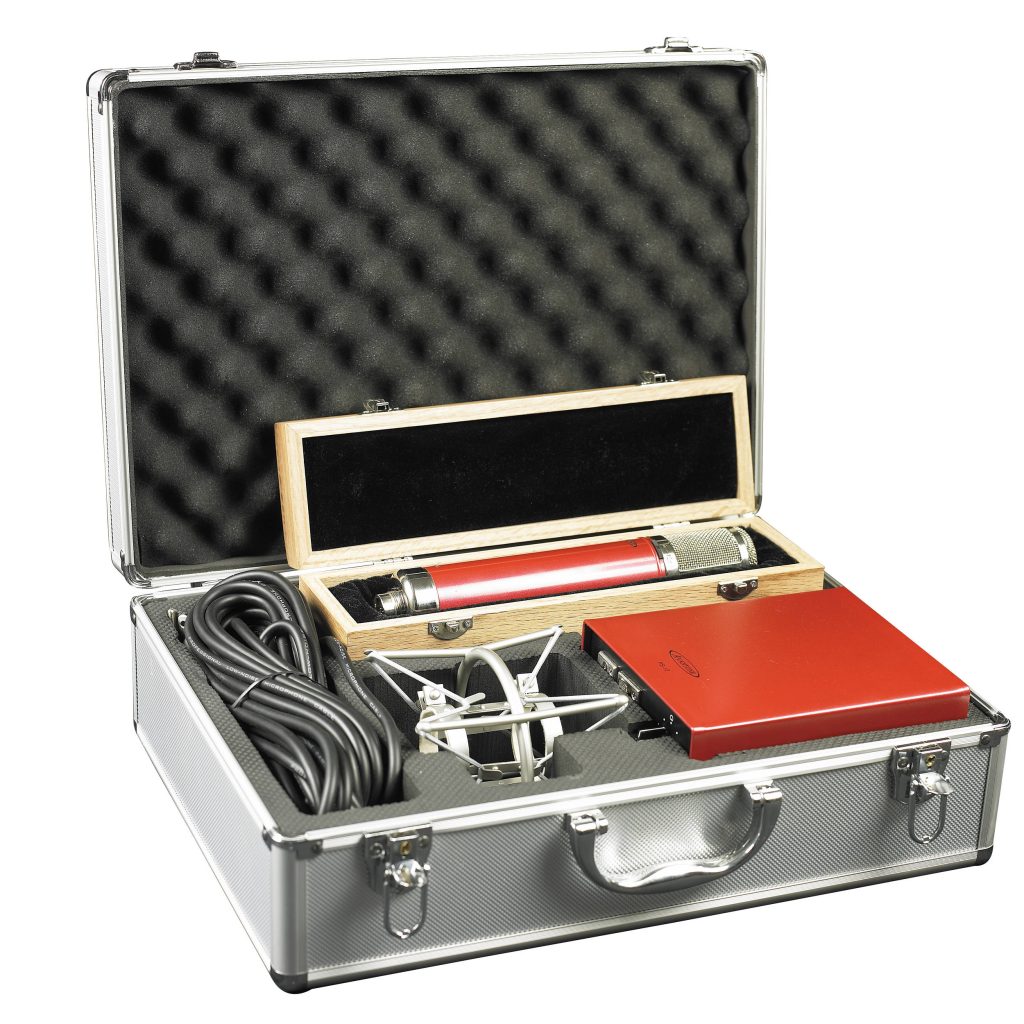
One of the first things to strike you with the CV-12 is the departure from the colour of its somewhat namesake, and that of a lot of modern microphones. Finished in a striking red colouration across the body of the microphone, with a more polished ‘chrome-like’ finish on hardware such as the grille, and the fastener used to keep the microphone together. This red against silver colourway serves somewhat as a signature of Avantone Pro, with many of their products sharing this same look. It looks great, and trust me when I say the finish is extremely durable. (Ask me how I know!!)
The microphone generally feels pretty solid in the hand, as will also be the case with tube microphones, where the body isn’t just home to circuitry, but also a full-sized tube and an output transformer; all this quickly adds to the heft and weight of the unit.
The microphone itself is also home to a pair of switches: a -10dB pad, useful when recording really hot sources, such as a close-miked guitar amp, and an 80Hz High-Pass Filter, useful for filtering out any low-end rumble.
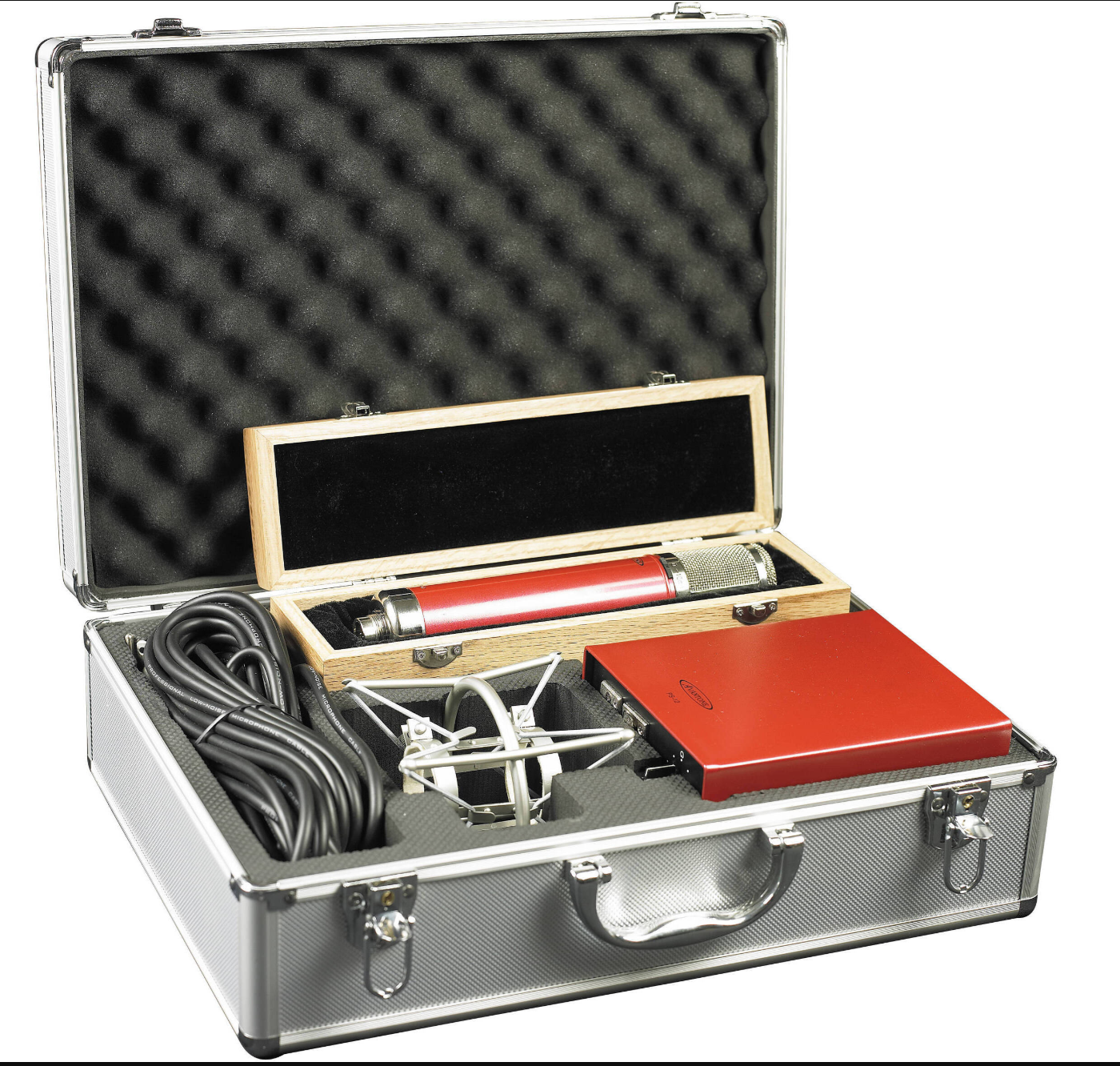
The microphone also comes with a whole host of additional paraphernalia including: a shock mount (with spare elastics), a power supply, a good-sized 7-pin XLR, and a wooden box for the microphone that securely holds it. All of this comes in its own flight case with a custom-cut foam insert with spaces for the microphone (in its box), the power supply, the cabling, shock mount, and a few spaces for storing a couple spare tubes you might have. I love when a package like this comes with an external case, as it just makes keeping everything nice and neatly stored together.
The Power Supply, like many that come with tube mics, doesn’t just power the microphone, but also features the rotary switch that allows you to control the pick-up polar pattern of the microphone; the CV-12 features nine settings here: Omnidirectional, Cardioid and Figure-of-Eight, with ?? intermediary positions between each, which leads to plenty of capturing options.
In Use
If I had to describe what the CV-12 does in a very succinct way, I would just say that it ‘adds character’. But what does this actually mean? Well, like pretty much all tube microphones, the CV-12 isn’t trying to be transparent; it isn’t just about capturing a source accurately, but about adding a little extra. It adds weight to certain sources, while capturing a well-rounded midrange, while also capturing an open top end, but due to the tube circuitry and how the microphone is voiced, on most sources this avoids the microphone sounding clinical in the high frequencies.
Does it work well on all sources? No, of course not; I would love to be shown the microphone that does. If you stick this up in front of a particularly bright, nasally, or even sibilant singer, I am not sure you will like the results. Obviously, you can play around with spacing and the angle of the microphone, but in those situations, it might be worth reaching for something else. This also gives good potential to play around with the polar patterns, to see how different patterns affect frequency response, off-axis response, and more.
Like with many large-diaphragm microphones, the first thing people will think of using it on is vocals, and for many kinds, this will be a solid choice. Something this microphone does quite well is give a more rounded body to a vocalist, which can be great for a vocalist who lacks that naturally. That added body and thickness can stop you having to reach for corrective EQ early in the process, something I also prefer to avoid, if I can.
With the singer right ‘on-top’ of the microphone in cardioid, you get a nice amount of proximity effect, which further adds low-end, but if you want to get close but don’t enjoy the amount of proximity, then keep the positioning, but change the polar pattern; try a click to the left of cardioid, which starts to lean towards a cardioid with a hint of omnidirectional.
For most vocal applications, cardioid (or an intermediary of cardioid) will be your go-to, but that doesn’t mean the others are useless in these situations. The figure-eight works well for picking up a duo of singers, and omnidirectional is a solid choice for capturing an ensemble crowded around it, or a single singer in a space with a nice natural ambience you wish to capture.
Outside of vocal applications, the CV-12 can definitely put a shift in across a whole host of other sources.
On an acoustic guitar, you can get a lovely warmth, while still retaining high-frequency detail, and if you want to cut some boom and rumble, then the 80Hz high-pass filter is great.
It also does a solid job when paired with a dynamic microphone on a guitar amp, with the ability to add some extra oomph you might look to a ribbon microphone for, but with additional top-end and a sense of dimension. This can be a slight detriment when working with a ‘spittier’ sounding amp, but that is the point where you start to play around with amp and pedal settings to compensate.
A great well-balanced piano sound is possible, either with a single CV-12 backed off the piano, a closer one in figure-8 or omni, or if you feel so inclined, a pair of them, one focusing on the lower strings, and the other on the higher strings of the piano. The detail really shines through.
With a max SPL of 136dB, which ‘rises’ to 146dB with the pad engaged, it means you can use the CV-12 on even louder sources, and that is where it becomes a great option for a whole host of applications on the drum kit. Maybe you want a decent Kick Out mic, maybe you want a Side-Snare to add weight, maybe you want something in omni or Figure-of-8 to capture Toms, maybe a single Omni Overhead (or a pair in cardioid), or maybe a short or long-distance room mic; the CV-12 has you covered.
The CV-12 is as versatile as they come.
Wrapping Up
There are always two questions I love to ask at the end of a review of an item that is based on or inspired by a vintage product: ‘Does it sound like the original?’ And ‘Is it any good?”
So, does the CV-12 sound like an actual AKG C12? No, of course not; there are clearly design differences, there are circuit differences, and even the capsule used is different than what would be found in the original. So no, it doesn’t scream C12.
But, to lead into the second question, is it any Good? Overall, I would say yes, especially at its price point. It is a solid low-cost option for entering the world of the tube microphone. There are definitely sources that will be elevated by putting the CV-12 in front of them, and as mentioned in the vocal section of the review, there will also be sources that don’t particularly enjoy the top-end reproduction of this microphone.
As always, one person’s favourite microphone might be someone else’s least favourite, and to use a somewhat British equivalence, the CV-12 could definitely be the Marmite microphone. Love it, or hate it.
Aside from the love-or-hate top end, the other drawbacks of this microphone are the same as any tube microphone: you are dealing with the additional needs of tube circuitry. You have to use the included power supply, you have to use a special 7-pin XLR, and you have to allow the microphone to warm up once switched on to get the best results. Some of you won’t like the additional workflow; others will find it negligible.
All in all, the Avantone Pro CV-12 is, overall, an incredibly solid and versatile microphone that will, on many sources, elevate the sound, impart the tube sound, and grant a level of openness and dimension that other types of microphones lack.
Especially at its current low-price point, I don’t think many will be too disappointed with what this can offer.
In terms of alternatives, it can be a bit tricky, because the current price point of the CV-12 is quite a bit lower than other options. That said, if you are happy to spend around £100-300 more, you have options such as the Rode K2, the MXL Revelation 2, and the Lauten Audio LA-320 V2. For about £200 extra you could also look into the Avantone Pro CV-12BLA, which is a CV-12 that has been given the modding treatment as a collaboration between Avantone Pro and Black Lion Audio.
I will also add another thought: while I don’t normally talk about DIY options in reviews, the CV-12 is often a choice for people in the modding community, who enjoy taking this microphone and straight up swapping the microphone capsule with something closer resembling a K-12 style capsule, which revoices the microphone, and for some gives a sound that might be seen as more versatile. But as ever, each to their own on that.
Avantone CV-12
£299/€349/$399
https://avantonepro.com/en/products/cv-12